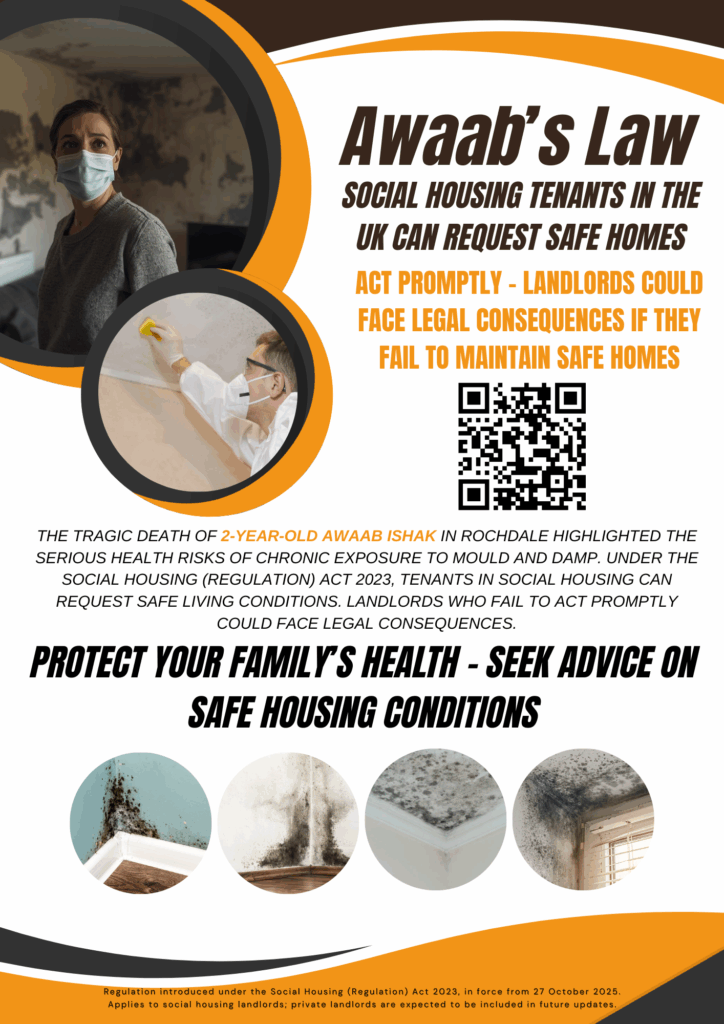

Awaab’s Law
Awaab’s Law – New UK Rules on Damp, Mould and Ventilation
Awaab’s Law is a new housing regulation introduced in the UK after the tragic death of 2-year-old Awaab Ishak, caused by prolonged exposure to mould in social housing.
The law forces landlords to respond quickly to damp, mould, and ventilation issues, giving tenants strong legal protection and improving housing standards nationwide.
Awaab’s Law applies across the UK and is especially important in areas with high humidity such as Scotland – including Edinburgh, Glasgow, Fife and surrounding regions.
What Is Awaab’s Law?
Awaab’s Law introduces strict response deadlines for landlords when tenants report damp or mould. These deadlines ensure that dangerous living conditions cannot be ignored.
Legal response times under Awaab’s Law
-
24 hours – If there is an urgent health and safety risk, action must start immediately.
-
14 days – Landlords must inspect any reported damp/mould issue.
-
7 days – Repairs must begin after the inspection.
Failure to comply can lead to fines, enforcement action, or legal consequences for landlords.
Why Awaab’s Law Matters
Damp and mould can cause respiratory issues, asthma, allergies, and long-term health problems. Before Awaab’s Law, many tenants waited months or years for repairs.
The new rules ensure:
-
fast repairs and clear deadlines,
-
safe, healthy homes,
-
better indoor air quality,
-
less damp, mould and condensation,
-
greater landlord responsibility and accountability.
It is one of the strongest tenant-protection laws ever introduced in the UK.
How Awaab’s Law Changes Housing Standards in Practice
The law forces landlords and housing associations to:
-
take damp and mould reports seriously,
-
inspect and act quickly,
-
improve ventilation, not just “cover up” the mould,
-
invest in long-term solutions instead of temporary fixes,
-
document repairs and maintain compliance.
In Scotland, where damp is particularly common due to climate and older building stock, Awaab’s Law accelerates upgrades such as:
-
MVHR (Mechanical Ventilation with Heat Recovery)
-
DMVHR (Decentralised / Single-Room Heat Recovery Units)
These systems help landlords meet legal ventilation standards, reduce mould risk, and improve energy efficiency.
Benefits for Tenants and Homeowners
Awaab’s Law improves living conditions for millions of UK residents by ensuring:
-
healthier indoor environments,
-
protection for children and vulnerable people,
-
reduced risk of condensation, mould and damp,
-
more reliable landlord response times,
-
safer housing across both social and private sectors (as the law expands).
For homeowners, installing modern ventilation systems also increases property value, reduces heating bills, and prevents structural damage caused by moisture.
Conclusion
Awaab’s Law marks a major shift in how the UK handles damp, mould, and ventilation problems.
It introduces clear deadlines, stronger protections, and real consequences for inaction.
For tenants, it means safer homes. For landlords, it requires faster repairs and long-term ventilation improvements.